

Many women understand the importance of protecting their time, energy, and emotional well-being. They know when they are overwhelmed, stretched too thin, or carrying responsibilities that should not belong solely to them. Yet despite this awareness, setting boundaries often feels incredibly difficult. Even when the need is obvious, many women find themselves saying “yes” when they want to say “no,” avoiding difficult conversations, or feeling guilty for prioritizing their own needs.
The challenge is not a lack of knowledge. Most women already know that healthy relationships require limits and mutual respect. The difficulty lies in the emotions attached to setting boundaries. Fear of disappointing others, concerns about being perceived as selfish, and years of conditioning to put everyone else first can make setting boundaries feel uncomfortable. Understanding why this happens is the first step toward creating healthier relationships and protecting your mental well-being.
What Does Setting Boundaries Really Mean?
Before exploring why it feels so difficult, it is important to understand what setting boundaries actually involves.
Boundaries are the limits we establish to protect our emotional, physical, mental, and personal well-being. They help define what is acceptable and what is not in our relationships, work environments, and daily interactions.
Setting boundaries can look like:
- Saying no to commitments that exceed your capacity
- Limiting contact with people who consistently drain your energy
- Asking for respect in conversations
- Protecting personal time for rest and self-care
- Communicating your needs clearly and honestly
- Declining requests that conflict with your values or priorities
Contrary to common misconceptions, setting boundaries is not about controlling other people. It is about communicating what you need to feel safe, respected, and emotionally healthy.
Why Many Women Struggle With Setting Boundaries
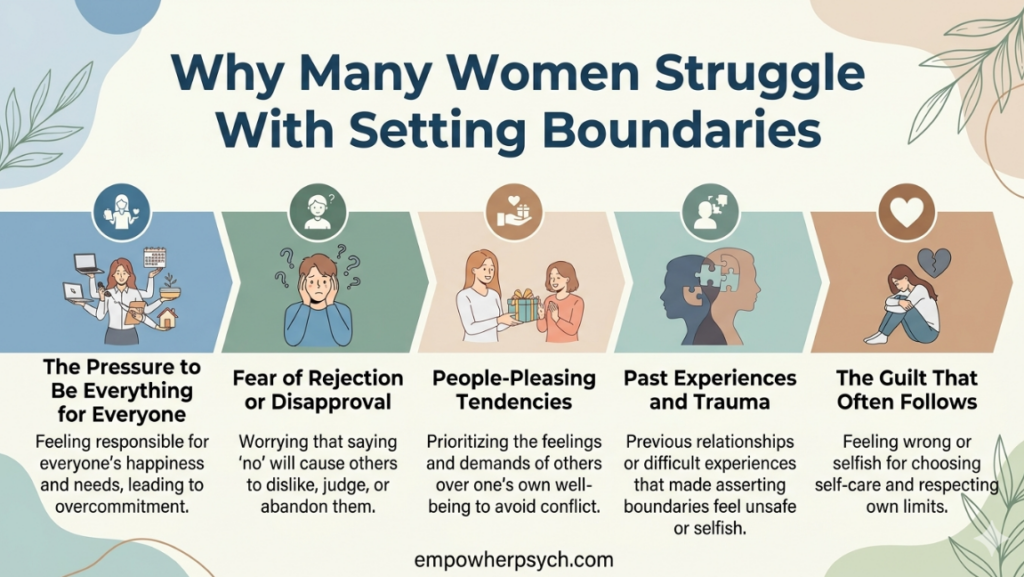
If setting boundaries seems straightforward, why does it feel so challenging?
The answer often lies in a combination of social expectations, past experiences, and emotional patterns that develop over time.
1. The Pressure to Be Everything for Everyone
Many women are taught from an early age to be caring, accommodating, and selfless. While these qualities can be valuable, they sometimes come at the expense of personal well-being.
Women are often praised for:
- Being helpful
- Putting others first
- Keeping the peace
- Avoiding conflict
- Meeting everyone’s needs
Over time, these messages can create the belief that saying no is rude, selfish, or uncaring. As a result, setting boundaries may feel like you are letting others down, even when your needs are completely reasonable.
2. Fear of Rejection or Disapproval
One of the biggest barriers to setting boundaries is the fear of how others might react.
Questions such as these often arise:
- Will they be upset with me?
- Will they stop liking me?
- Will they think I am selfish?
- Will this damage the relationship?
These fears can be powerful. For many women, maintaining connection feels emotionally safer than risking disapproval. Unfortunately, constantly prioritizing other people’s comfort over your own needs can lead to resentment, exhaustion, and emotional distress.
3. People-Pleasing Tendencies
People-pleasing is another common reason setting boundaries feels difficult.
People-pleasing often develops as a way to gain acceptance, avoid conflict, or maintain harmony in relationships. While it may create temporary comfort, it often comes with significant emotional costs.
Women who struggle with people-pleasing may:
- Overcommit themselves
- Avoid expressing disagreement
- Take responsibility for other people’s emotions
- Feel guilty when prioritizing themselves
- Constantly seek validation from others
When these patterns become deeply ingrained, setting boundaries can feel uncomfortable because it challenges long-standing habits.
4. Past Experiences and Trauma
Previous experiences can significantly influence how comfortable someone feels with setting boundaries.
Women who have experienced emotional neglect, trauma, criticism, or unhealthy relationships may have learned that expressing needs is unsafe. In some cases, boundaries may have been ignored, dismissed, or punished.
As a result, setting boundaries can trigger feelings of anxiety, fear, or vulnerability. Even when a current relationship is healthy, old emotional wounds may still make boundary-setting feel risky.
5. The Guilt That Often Follows
Many women experience guilt immediately after setting boundaries.
This guilt may sound like:
- I should be able to do more.
- Maybe I am being selfish.
- They need me.
- I do not want to hurt anyone’s feelings.
The reality is that guilt does not always mean you are doing something wrong. Sometimes guilt simply reflects that you are doing something unfamiliar.
If you have spent years prioritizing others, setting boundaries may feel uncomfortable at first because it represents a significant shift in behavior. Discomfort does not mean the boundary is wrong. It often means growth is taking place.
The Hidden Cost of Not Setting Boundaries
Avoiding setting boundaries may seem easier in the moment, but the long-term consequences can be significant.
Without healthy boundaries, many women experience:
- Chronic stress
- Emotional exhaustion
- Burnout
- Anxiety
- Resentment toward loved ones
- Reduced self-esteem
- Difficulty maintaining healthy relationships
When personal limits are repeatedly ignored, emotional well-being often suffers. Over time, this can affect physical health, relationships, career performance, and overall quality of life.
Setting boundaries is not selfish. It is an essential part of maintaining emotional balance and protecting mental health.
Signs You May Need Stronger Boundaries
Sometimes women become so accustomed to overextending themselves that they fail to recognize when boundaries are needed.
Consider whether any of these situations sound familiar:
- You frequently feel overwhelmed by responsibilities.
- You struggle to say no.
- You feel responsible for other people’s happiness.
- You often feel resentful after agreeing to help someone.
- You rarely make time for yourself.
- You feel emotionally drained after certain interactions.
- You worry excessively about disappointing others.
If several of these signs resonate with you, setting boundaries may be an important step toward improving your emotional well-being.
How to Start Setting Boundaries Without Feeling Overwhelmed
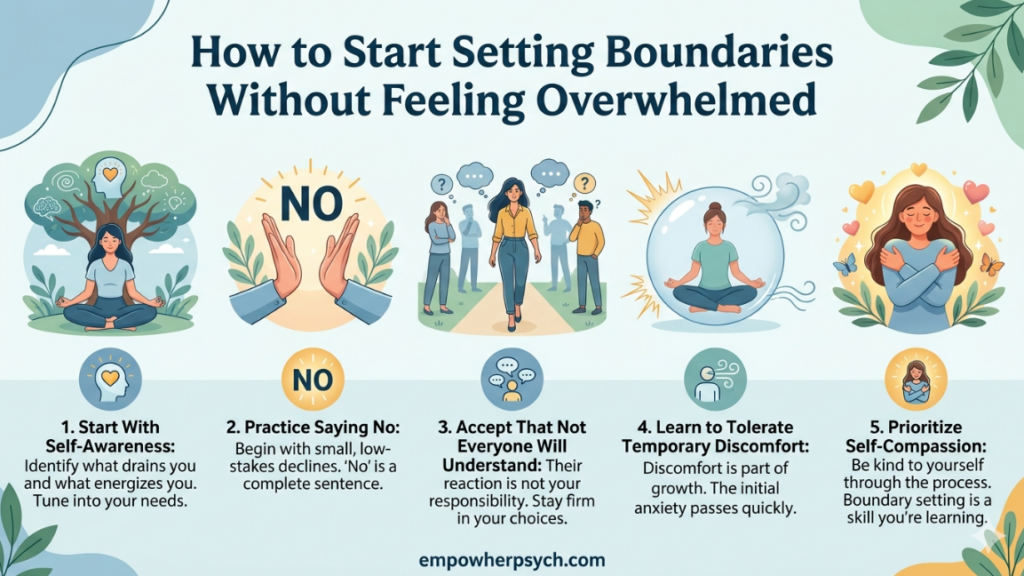
The idea of setting boundaries can feel intimidating, especially if it is something you have rarely practiced. Fortunately, boundaries do not have to be dramatic or confrontational.
Small, consistent steps can create meaningful change.
1. Start With Self-Awareness
Before setting boundaries with others, take time to identify your own needs.
Ask yourself:
- What situations leave me feeling exhausted?
- Where do I feel taken advantage of?
- Which relationships feel unbalanced?
- What do I need more of in my life?
Understanding your emotional triggers can help clarify where boundaries are needed most.
2. Practice Saying No
Many women fear that saying no will damage relationships. In reality, healthy relationships can withstand respectful boundaries.
Simple responses may include:
- I cannot commit to that right now.
- I need some time to think about it.
- That does not work for my schedule.
- I appreciate you asking, but I have to decline.
You do not need lengthy explanations or apologies. Clear and respectful communication is often enough.
3. Accept That Not Everyone Will Understand
One of the hardest truths about setting boundaries is that some people may not like them.
Individuals who benefit from unlimited access to your time and energy may resist change. This does not mean your boundaries are wrong.
Healthy relationships are built on mutual respect. People who genuinely care about your well-being will learn to respect your limits, even if it takes time.
4. Learn to Tolerate Temporary Discomfort
Setting boundaries often feels uncomfortable before it feels empowering.
The initial anxiety, guilt, or fear that may arise does not necessarily indicate a problem. These feelings are often part of breaking old patterns.
The more consistently you practice setting boundaries, the more natural it becomes.
5. Prioritize Self-Compassion
Many women are far kinder to others than they are to themselves.
As you practice setting boundaries, remind yourself:
- My needs matter.
- I deserve rest.
- I am not responsible for everyone’s emotions.
- Protecting my well-being is healthy.
- Saying no does not make me selfish.
Self-compassion can help reduce guilt and reinforce healthier habits over time.
Setting Boundaries Is an Act of Self-Respect
At its core, setting boundaries is not about pushing people away. It is about creating relationships that allow you to show up as your healthiest, most authentic self.
Healthy boundaries make room for mutual respect, emotional safety, and genuine connection. They allow you to give from a place of choice rather than obligation. They help preserve your energy so you can care for yourself and others without sacrificing your own well-being.
The more you practice setting boundaries, the more you begin to recognize that your needs are not burdens. They are important parts of who you are and deserve to be acknowledged.

Ready to Stop Feeling Guilty for Protecting Your Peace?
If setting boundaries feels impossible, overwhelming, or emotionally exhausting, you are not alone. Many women struggle with the fear, guilt, and uncertainty that can accompany boundary-setting. The good news is that these skills can be learned, strengthened, and supported over time.
At EmpowHer Psychiatry and Wellness, we understand the unique challenges women face when balancing relationships, responsibilities, and mental well-being. Whether you are navigating anxiety, stress, life transitions, or emotional burnout, our compassionate team is here to help you build healthier patterns, strengthen your confidence, and create the life you deserve. Reach out today and take the first step toward protecting your peace, honoring your needs, and embracing the power of setting boundaries.
