

Trauma in women is everywhere—but it’s rarely recognized for what it actually is. It doesn’t always look like crisis, breakdown, or obvious emotional pain. More often, it hides in plain sight: in overthinking every decision, saying “yes” when you mean “no,” feeling emotionally exhausted for no clear reason, or constantly questioning your worth in relationships, work, or everyday interactions.
Because these patterns are so normalized, many women don’t identify them as trauma responses. They see them as personality traits. They believe they are “just anxious,” “too sensitive,” or “bad at handling stress.” But in reality, these are often deeply learned survival strategies—patterns shaped by past experiences that taught the brain how to stay safe, even at a cost.
Understanding trauma through this lens changes everything. It shifts the question from “What’s wrong with me?” to “What happened to me—and how is it still affecting me today?” That shift is where healing begins.
What Trauma Really Means (Beyond the Clinical Definition)
Trauma is not defined by the intensity of an event—it’s defined by the impact it leaves on your nervous system.
At its core, trauma happens when:
- You feel overwhelmed and unable to cope
- You feel unsafe, unsupported, or emotionally exposed
- Your brain cannot fully process or resolve the experience
This is why trauma is deeply personal. Two people can go through the same situation, and only one may experience it as traumatic. The difference lies in perception, support, timing, and emotional capacity—not in “strength.”
For women, trauma often includes experiences that are dismissed or normalized, such as:
- Growing up feeling unseen, unheard, or emotionally unsupported
- Being constantly criticized, compared, or invalidated
- Navigating relationships where boundaries were ignored
- Experiencing subtle but repeated forms of disrespect or control
- Carrying long-term stress from caregiving, financial pressure, or social expectations
These experiences don’t always leave visible scars—but they shape internal beliefs, emotional reactions, and behavioral patterns in powerful ways.
Why Trauma in Women Is So Often Dismissed or Misdiagnosed
One of the biggest barriers to healing is that trauma in women is frequently misunderstood—overlooked not only in society, but also within clinical settings and deeply rooted cultural narratives.
Here’s where things go wrong:
- Emotional pain is minimized. Women are often told they are “overreacting” rather than overwhelmed
- Coping mechanisms are praised. Self-sacrifice, silence, and emotional endurance are often seen as strengths
- Symptoms are mislabeled. Trauma responses are frequently diagnosed as anxiety, depression, or mood disorders without addressing root causes
- High-functioning masks the struggle. Many women continue performing daily responsibilities while silently struggling
This leads to a critical gap: women receive support for symptoms, but not for the underlying trauma driving them.
And when the root isn’t addressed, the patterns don’t disappear—they repeat.
Why No Two Trauma Responses Are the Same
There is no universal trauma response—and expecting one is part of the problem.
Women respond differently to trauma based on:
- Early childhood experiences and attachment styles
- The presence—or absence—of emotional support
- Cultural expectations around gender and behavior
- Personality traits and coping tendencies
- Biological sensitivity to stress and threat
For example:
- One woman may become hyper-independent, avoiding reliance on others
- Another may become highly relational, fearing abandonment and seeking reassurance
- Another may disconnect emotionally, struggling to feel anything at all
These are not flaws. They are adaptive responses—ways the brain learned to maintain safety in uncertain or painful environments.
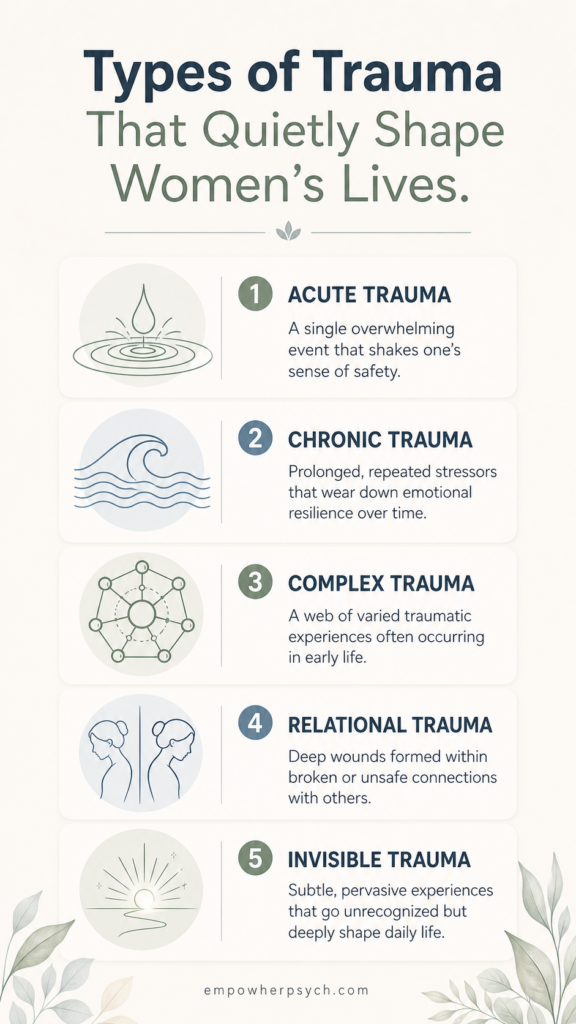
Types of Trauma That Quietly Shape Women’s Lives
Not all trauma in women is loud or immediately visible—in fact, some of the most impactful experiences are the quiet, subtle ones that often go unnoticed but deeply shape daily life.
Here are the most common types of trauma affecting women:
- Acute trauma: A single distressing event (accident, assault, sudden loss)
- Chronic trauma: Repeated exposure to stress (toxic work environments, ongoing conflict, financial instability)
- Complex trauma: Layered experiences over time, often rooted in childhood
- Relational trauma: Emotional harm within close relationships (neglect, betrayal, inconsistency)
- Invisible trauma: Experiences that are minimized or normalized but deeply felt
Invisible trauma is especially important to recognize because it often goes unvalidated—both by others and by the person experiencing it.
And what goes unvalidated often goes unhealed.
How Trauma Shows Up in Everyday Behavior
Trauma rarely announces itself directly. Instead, it shows up as patterns that feel automatic, confusing, or hard to control.
You might notice:
- Overthinking simple decisions and replaying conversations
- Feeling responsible for other people’s emotions
- Struggling to say no without guilt
- Avoiding conflict—even when something matters to you
- Feeling emotionally drained in relationships
- Constantly seeking validation or reassurance
- Feeling disconnected from yourself or your needs
These patterns are not random. They are learned responses—your brain trying to predict, prevent, or protect against perceived threats.
How to Recognize a Trauma Trigger Before It Escalates
When it comes to trauma in women, triggers are not always obvious—they often appear as subtle emotional shifts that feel disproportionate to the moment, rather than clear or intense reactions.
Common early signs include:
- A sudden sense of tension or unease
- Feeling unusually sensitive to tone, words, or body language
- A strong urge to withdraw, shut down, or escape
- Rapid overthinking or emotional spiraling
- Physical sensations like tightness in the chest, shallow breathing, or fatigue
Recognizing trauma triggers early is powerful because it creates a gap between stimulus and response. In that gap, you regain choice.
Instead of reacting automatically, you can begin responding intentionally.
The Hidden Survival Patterns Behind Trauma Responses
Many behaviors women struggle with are often misunderstood, but in reality, they are deeply rooted patterns of trauma in women—survival responses that develop quietly and operate beneath the surface.
These include:
- People-pleasing: Avoiding conflict to maintain safety
- Perfectionism: Controlling outcomes to reduce uncertainty
- Hyper-independence: Avoiding vulnerability to prevent disappointment
- Emotional numbness: Reducing sensitivity to avoid pain
- Over-explaining: Trying to prevent misunderstanding or rejection
At some point, these patterns worked. They helped you navigate difficult environments.
But what once protected you can later limit you—especially in relationships, decision-making, and self-trust.
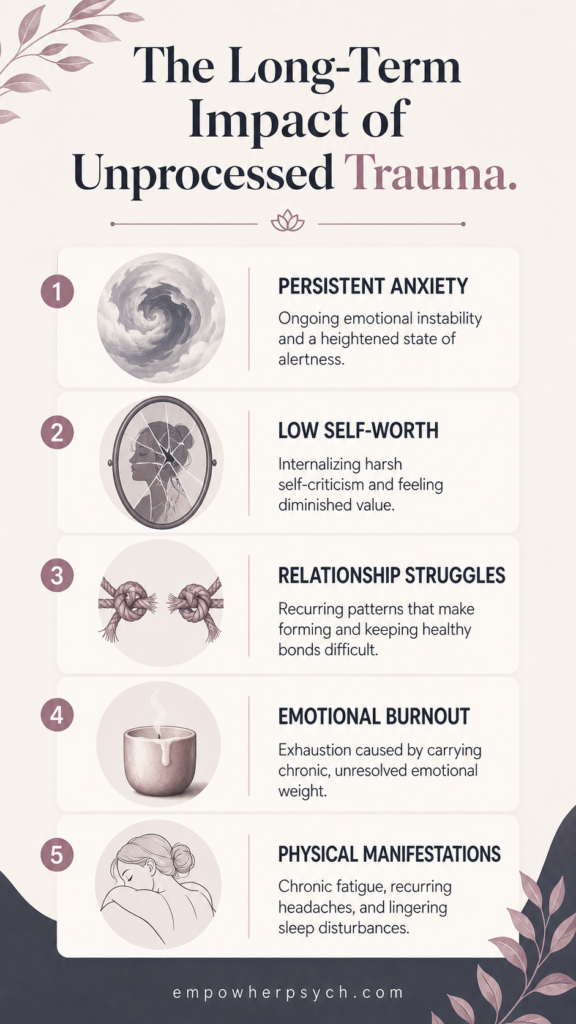
The Long-Term Impact of Unprocessed Trauma
When trauma in women goes unprocessed, it rarely stays contained—it often extends into multiple areas of life, influencing emotional well-being, relationships, and daily functioning.
Over time, it can lead to:
- Persistent anxiety or emotional instability
- Low self-worth and harsh self-criticism
- Difficulty forming or maintaining healthy relationships
- Burnout from chronic emotional stress
- Physical symptoms such as fatigue, headaches, and sleep disturbances
What makes this challenging is that these effects often develop gradually. They become normalized, making it harder to recognize their root cause.
Why Talk Therapy Is a Powerful Tool for Healing Trauma
Talking about trauma can feel uncomfortable—but avoiding it often keeps the cycle going.
Therapy works because it helps you:
- Process experiences in a safe, structured environment
- Identify patterns you may not consciously see
- Reframe beliefs shaped by past experiences
- Learn tools to regulate emotional and physical responses
- Build a stronger sense of self-awareness and control
It’s not about reliving everything—it’s about understanding it differently.
That difference is what creates change.
What Healing From Trauma Actually Looks Like in Real Life
Healing is often misunderstood as a state of “being completely okay,” but for trauma in women, healing is actually a gradual process of becoming more aware, more grounded, and more in control of emotional and physical responses over time.
Healing can look like:
- Pausing before reacting to a trigger
- Setting boundaries without over-explaining
- Feeling emotions without being overwhelmed by them
- Letting go of the need to constantly prove your worth
- Building relationships that feel safe and reciprocal
Healing is not a straight line. It’s a process of learning, unlearning, and gradually shifting how you relate to yourself and others.
Trauma Quotes That Help You Feel Seen and Understood
Sometimes, words can capture what feels impossible to explain.
Here are a few that resonate deeply with many women:
- “Your coping mechanisms were once your protection.”
- “You are allowed to take up space, even if you were taught not to.”
- “Healing is not about forgetting—it’s about reclaiming control.”
These ideas don’t fix everything—but they can help reframe how you see your own experience.
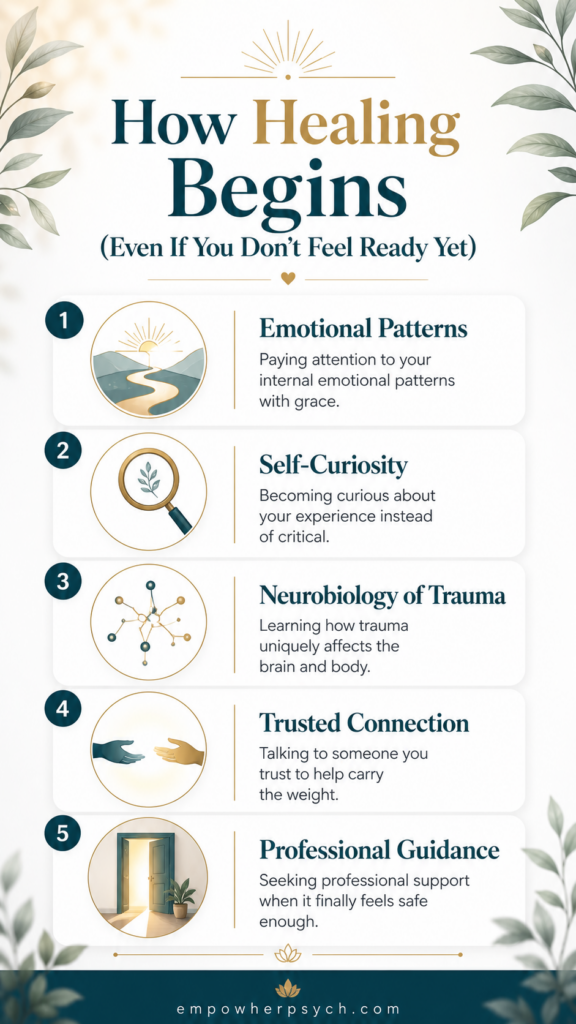
How Healing Begins (Even If You Don’t Feel Ready Yet)
One of the most common misunderstandings around trauma in women is the belief that healing can only begin once you feel fully ready.
In reality, readiness is often something that develops through the process—not something you wait for beforehand.
You can begin by:
- Paying attention to your emotional patterns
- Becoming curious instead of critical toward yourself
- Learning how trauma affects the brain and body
- Talking to someone you trust
- Seeking professional support when it feels safe enough
You don’t need to have everything figured out. You just need to take one step.
Break the Silence Around Women’s Trauma and Start Healing Today
Trauma in women is often invisible—but its impact is real, layered, and deeply personal. When you begin to understand how your past experiences have shaped your thoughts, behaviors, and emotional responses, something powerful happens: you stop blaming yourself for patterns that were never random to begin with.
And that understanding creates space for change—not overnight, but gradually, intentionally, and in a way that actually lasts.
If you’re starting to recognize your own patterns, triggers, or emotional responses in this, you don’t have to navigate it alone. At EmpowHer Psychiatry and Wellness, you’ll find a safe and supportive space where your experiences are taken seriously, your story is heard without judgment, and your healing process is guided with care. Whether you’re just beginning to explore your past or you’re ready to actively work through it, reaching out could be the step that helps you feel more grounded, more in control, and more like yourself again.
