

Choosing yourself shouldn’t feel like a betrayal—but for many women, it does.
If you’re reading this, there’s a good chance you’re standing at a crossroads. Maybe you’re setting boundaries for the first time. Maybe you’re stepping away from a relationship, a role, or expectations that no longer fit. Or maybe you’re simply trying to care for your mental health in a world that keeps asking you to put everyone else first.
And yet, instead of relief, what shows up is guilt.
This article is about letting go of guilt—not in a surface-level, “just think positive” way, but in a deeply grounded, psychologically informed way. Whether you’re navigating change yourself or supporting a loved one who is struggling, understanding where guilt comes from—and how to loosen its grip—can be a powerful step toward healing.
Why Choosing Yourself Feels So Hard
For many women, guilt is not a sign that something is wrong—it’s a sign that you’ve been conditioned to prioritize others over yourself.
From a young age, women are often praised for being:
- Selfless
- Accommodating
- Emotionally available
- Responsible for harmony
So when you start choosing rest, boundaries, or mental health, your nervous system may interpret that as danger—not freedom.
This is especially true during life transitions in women, when identity shifts are already underway. Change disrupts familiar roles, and guilt rushes in to pull you back to what feels “safe,” even if it’s harmful.
Letting go of guilt doesn’t mean you stop caring. It means you stop abandoning yourself.
Guilt vs. Responsibility: An Important Distinction
One of the biggest barriers to letting go of guilt is confusion between guilt and responsibility.
- Healthy responsibility says: “I care about the impact of my actions.”
- Chronic guilt says: “I am responsible for everyone else’s feelings, even at the cost of my own well-being.”
Mental health professionals often see guilt intensify when someone:
- Sets boundaries with family
- Prioritizes treatment or therapy
- Takes space from emotionally draining relationships
- Says no without overexplaining
Letting go of guilt does not mean ignoring others—it means recognizing where your responsibility ends.
How Guilt Impacts Mental Health

Unresolved guilt doesn’t stay quiet. Over time, it can show up as:
- Anxiety or constant second-guessing
- Depression and emotional exhaustion
- Difficulty making decisions
- Resentment toward loved ones
- Physical symptoms like headaches or tension
In psychiatric care, guilt is often linked to:
- Trauma histories
- Anxiety disorders
- Depression
- Adjustment disorders during life transitions
This is why letting go of guilt is not just emotional work—it’s mental health care.
Why Guilt Often Appears During Life Transitions
Major life changes tend to expose guilt because they force you to ask hard questions:
- Who am I if I stop doing this for everyone else?
- What if my needs disappoint people?
- What if choosing myself changes relationships forever?
Transitions such as divorce, parenthood, career changes, caregiving shifts, or healing from trauma often require redefining roles. Guilt shows up as resistance to that redefinition.
This doesn’t mean your choice is wrong. It often means it’s necessary.
Letting Go of Guilt Starts With Understanding Its Origin
You cannot release guilt you don’t understand.
Ask yourself:
- Was I taught that my worth comes from being needed?
- Did I learn that rest equals laziness?
- Was I rewarded for silence instead of self-expression?
- Have I survived environments where saying no felt unsafe?
For trauma survivors, guilt can be a learned survival response—not a moral failing.
Letting go of guilt begins with compassion for why it developed.
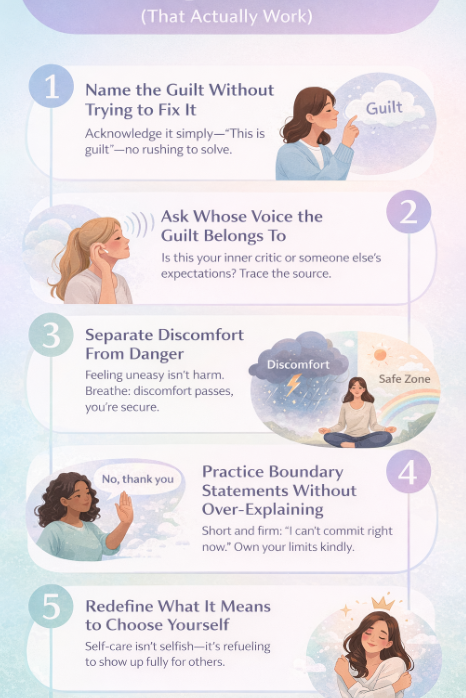
Practical Steps for Letting Go of Guilt (That Actually Work)

Letting go of guilt is not about forcing yourself to feel differently—it’s about learning how to respond to guilt with awareness, compassion, and intention rather than self-judgment.
1. Name the Guilt Without Trying to Fix It
Guilt often becomes overwhelming not because it exists, but because we immediately try to push it away or argue with it. When guilt is resisted, it tends to grow louder and more persistent.
Instead of fighting guilt, try noticing it:
“I feel guilt coming up right now.”
This simple act creates emotional space. You are no longer inside the guilt—you are observing it. Naming guilt reduces shame because it shifts the experience from “Something is wrong with me” to “Something is happening in me.”
From a mental health perspective, this technique helps regulate the nervous system. When emotions are named without judgment, the brain is less likely to spiral into anxiety, rumination, or self-blame. Over time, this practice makes letting go of guilt feel safer and more manageable, rather than forced.
2. Ask Whose Voice the Guilt Belongs To
Not all guilt is truly yours.
Many women carry guilt that was learned, absorbed, or inherited from family dynamics, cultural expectations, or past experiences. Asking where guilt comes from can weaken its authority.
When guilt shows up, gently explore:
- Is this my own value system speaking?
- Is this a family expectation I learned growing up?
- Is this a cultural message about being “selfless” or “strong”?
- Is this a trauma response trying to protect me from conflict or rejection?
Understanding the source of guilt doesn’t make it disappear instantly, but it helps you see that guilt is often a pattern, not a truth. This awareness is a powerful step in letting go of guilt because it allows you to choose your values consciously instead of reacting automatically.
3. Separate Discomfort From Danger
One of the reasons guilt feels so urgent is that it can mimic danger in the body. The heart races, the stomach tightens, and the mind searches for ways to make the feeling stop.
But guilt often signals discomfort—not harm.
Feeling uncomfortable does not mean you are doing something wrong. More often, it means you are stepping outside familiar patterns. Growth, boundary-setting, and healing almost always come with discomfort before relief.
Learning to pause and ask, “Am I actually in danger, or am I just uncomfortable?” can be transformative. This distinction helps retrain the nervous system to tolerate discomfort without immediately retreating into old behaviors that keep guilt alive.
4. Practice Boundary Statements Without Over-Explaining
Guilt thrives on over-explaining. When you feel guilty, you may find yourself offering long justifications, apologies, or emotional labor to make others feel better about your choices.
Clear, simple boundary statements help interrupt this cycle.
Examples include:
- “I need to focus on my mental health right now.”
- “I’m not available for that.”
- “This is what I need at this stage of my life.”
These statements may feel uncomfortable at first, especially if you were taught to earn permission for your needs. However, boundaries do not require validation from others to be valid.
5. Redefine What It Means to Choose Yourself
For many women, choosing themselves has been framed as selfish, irresponsible, or harmful. This belief keeps guilt deeply rooted.
In reality, choosing yourself is not abandonment—it is preservation.
Mental health care, therapy, medication management, rest, and emotional boundaries are not indulgences. They are acts of responsibility toward your long-term well-being. When you neglect yourself, the cost eventually shows up in burnout, resentment, or emotional collapse.
Supporting a Loved One Who Is Struggling With Guilt
If you’re reading this as a partner, parent, or caregiver, here’s what helps:
- Validate their experience without minimizing it
- Avoid language like “just don’t feel guilty”
- Encourage professional support when guilt interferes with functioning
- Remind them that choosing healing is not abandonment
Letting go of guilt is often easier when someone else believes your needs matter.
When Professional Support Can Help
Sometimes guilt is so ingrained that self-work isn’t enough—and that’s okay.
Psychiatric and therapeutic support can help when:
- Guilt is persistent and overwhelming
- It’s tied to trauma or anxiety
- It interferes with daily life or decision-making
- You feel stuck between obligation and burnout
A trauma-informed, women-centered approach can help unpack guilt safely—without forcing change before you’re ready.
Choosing Yourself Is a Process, Not a Switch

Letting go of guilt doesn’t happen all at once.
You may:
- Feel relief one day and guilt the next
- Question your decisions repeatedly
- Need reassurance while building self-trust
This doesn’t mean you’re failing. It means you’re learning.
Healing is rarely linear—especially during life transitions in women, where growth and grief often coexist.
A Final Word for the Woman Who Feels Torn
If no one has told you this yet, let it be said clearly: choosing yourself is not selfish. Rest is not weakness, boundaries are not rejection, and healing is not abandonment. Letting go of guilt is an act of courage—especially in a world that benefits from women staying silent, tired, and compliant. You are allowed to choose yourself, even when it’s uncomfortable, and especially then.
If you’re struggling to carry this weight alone, you don’t have to keep doing it by yourself. At EmpowHer Psychiatry and Wellness, we offer compassionate, women-centered psychiatric care designed to support you through guilt, life transitions, and emotional overwhelm. When you’re ready, we’re here to walk this path with you—at your pace, with care that honors your whole self.
