

It often starts quietly. A woman goes through the motions of her day — getting dressed, caring for family, going to work — yet somewhere along the way, she stops feeling. Joy doesn’t lift her; sadness doesn’t move her; even frustration feels muted. Friends might say she seems “fine,” but inside, it’s like living behind glass. This invisible disconnection has a name: Emotional Numbness.
For many women, this isn’t just stress or burnout. It’s a sign of deeper emotional fatigue often linked to depression — yet it’s one of the most commonly overlooked symptoms. Understanding Emotional Numbness is crucial because the silence it brings can delay healing, strain relationships, and distort one’s sense of self. This article explores what it really is, why it happens, and what steps can lead toward feeling again.
What Emotional Numbness Really Feels Like
Emotional Numbness doesn’t mean the absence of emotions entirely; it means being cut off from them. People experiencing it often describe life as flat, colorless, or disconnected.
Some common signs include:
- Difficulty feeling joy, sadness, or empathy even in intense situations
- A sense of detachment from one’s body or surroundings
- Going through daily routines on “autopilot”
- Finding it hard to connect deeply with others
- Feeling guilty for not reacting “normally” to events
In many cases, Emotional Numbness operates as a protective mechanism. The mind subconsciously shields itself from emotional pain, especially after prolonged stress, trauma, or loss. The problem arises when this shutdown becomes the new normal — when numbness outstays its purpose and turns into a symptom of depression in women.
Why Emotional Numbness Often Goes Unnoticed

From the perspective of mental health practitioners who work with women facing chronic stress and mood disorders, Emotional Numbness rarely appears suddenly. It tends to creep in quietly, disguised by busyness, responsibility, and the constant pressure to keep going. Women, in particular, often normalize this gradual disconnection, mistaking it for resilience rather than a subtle sign of emotional fatigue.
Here’s where things often go wrong: society rewards emotional control. Women are praised for “keeping it together,” for handling crises without crying, for staying calm under pressure. The very traits that earn admiration externally can mask internal depletion.
What most people don’t realize is that numbing isn’t strength — it’s exhaustion dressed up as stability.
This is usually overlooked, but it matters because numbness distorts perception. A woman may believe she’s handling life just fine when, beneath the surface, her nervous system is in a prolonged freeze state. Over time, that emotional flatness can morph into full-blown depression if left unaddressed.
Myths About Emotional Numbness
Let’s challenge a few misconceptions that often keep people stuck.
Myth 1: Emotional Numbness means you don’t care.
Not true. Most people who experience it desperately want to feel again but can’t. Their capacity hasn’t vanished; it’s temporarily offline due to exhaustion or depression.
Myth 2: You can fix it by “trying harder.”
Emotions don’t respond to willpower. You can’t force yourself to feel just because you recognize the problem. The key is addressing the underlying depression and restoring emotional safety.
Myth 3: It will pass on its own.
Sometimes it might fade with rest, but when numbness lingers for weeks or months, it’s usually a sign of something deeper. Hoping it’ll disappear can delay real recovery.
These myths matter because they feed self-blame. Many women think, “What’s wrong with me? Why can’t I just be happy?” Understanding that Emotional Numbness is a biological and psychological response — not a personal flaw — is the first step toward compassion and change.
The Importance of Mental Health Professionals

Addressing emotional numbness effectively often requires more than self-reflection — it needs professional support from people trained to guide emotional recovery. Seeking help isn’t a sign of weakness; it’s a sign of commitment to healing and growth.
Mental health professionals bring expertise and objectivity that self-help strategies alone can’t provide:
- Therapists can help identify emotional avoidance patterns, process trauma, and rebuild safe emotional expression.
- Psychiatrists assess biological factors and prescribe treatments — including medication for depression — when it has a strong chemical component.
- Counselors and Social Workers support lifestyle and relationship changes that reinforce emotional stability.
- Support groups connect individuals with others who understand what Emotional Numbness feels like, easing the isolation that often accompanies it.
- Integrated care providers (like psychiatrists partnering with therapists) ensure that treatment isn’t fragmented — addressing both mind and body together.
What most people don’t realize is that Emotional Numbness responds best to a holistic approach — emotional, physical, and social care working in tandem. Professionals create a safe environment to process complex feelings that might otherwise remain buried, helping individuals slowly reconnect to the parts of themselves that depression once muted.
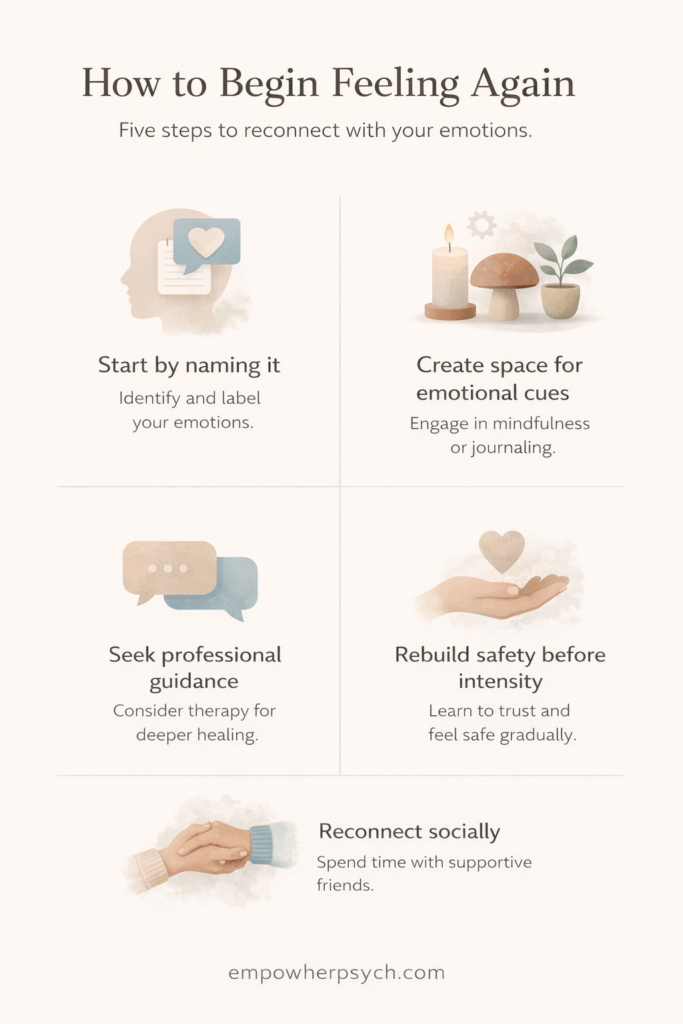
How to Begin Feeling Again

There’s no single roadmap that fits everyone, but certain approaches consistently help loosen the grip of Emotional Numbness.
1. Start by naming it
Awareness alone can be powerful. Recognizing that this flatness has a name validates the experience. It tells the brain, this isn’t permanent — it’s a signal that something needs attention.
2. Create space for emotional cues
Small practices like journaling, listening to music that used to move you, or simply pausing during your day to notice sensations in your body can help reconnect you to your emotional state. At first, it might feel empty — that’s okay. Think of it as exercising a muscle that has gone unused.
3. Seek professional guidance
Therapy remains one of the most effective ways to treat Emotional Numbness linked to depression. Cognitive Behavioral Therapy (CBT) helps identify patterns of avoidance. Somatic or trauma-informed therapy assists in reconnecting body and emotion. Sometimes, medication prescribed by a psychiatrist plays a necessary role in restoring balance.
4. Rebuild safety before intensity
People often rush to “feel happy again.” But it’s more sustainable to rebuild safety before joy. That might mean reducing overstimulation, setting boundaries, or simply resting without guilt. Emotional recovery happens when the nervous system feels secure enough to open up again.
5. Reconnect socially
Even light social contact — texting a friend, attending a support group, or volunteering — helps counteract emotional isolation. You don’t have to fake enthusiasm; just being present often restarts subtle feelings of connection.
Common Obstacles Along the Way
Even with awareness, a few hurdles can stall progress:
- Perfectionism: expecting instant recovery often backfires. Emotional work is layered, nonlinear, and messy.
- Overanalyzing: trying to intellectually “understand” feelings can sometimes reinforce disconnect. Feelings need to be felt, not solved.
- Isolation: numbness thrives in silence. Sharing your experience — even briefly — breaks its hold.
Recognizing these pitfalls doesn’t mean you’ll avoid them entirely, but it helps you recover faster when they appear.
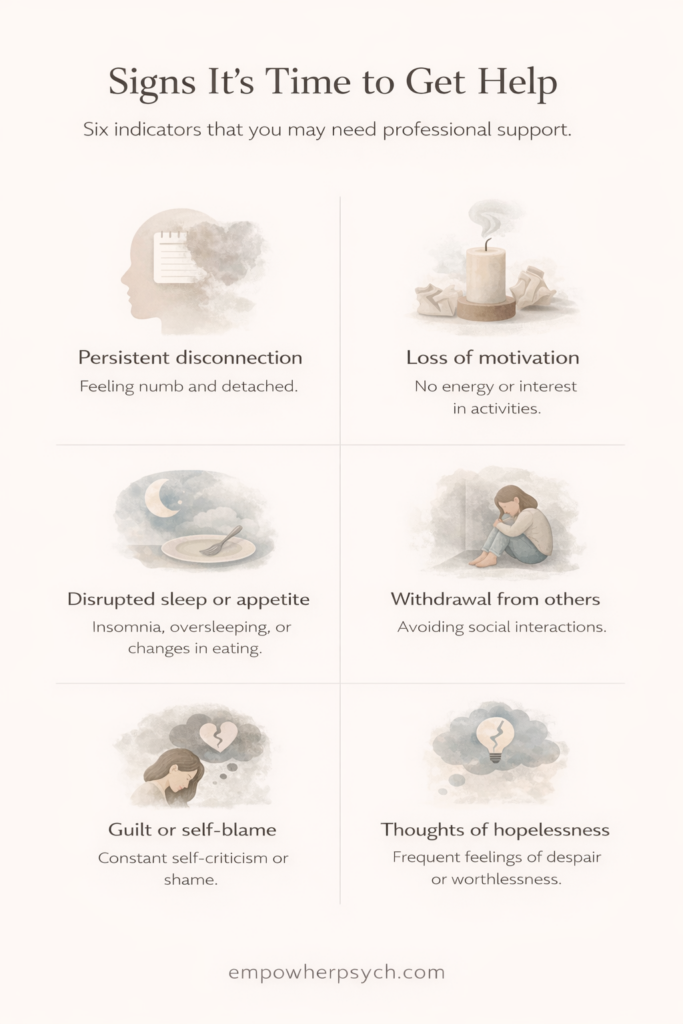
Signs It’s Time to Get Help
Recognizing when to reach out for professional support can be tricky, especially when Emotional Numbness has muted self-awareness. But certain signs suggest that what you’re experiencing isn’t just a passing phase — it’s a call for deeper attention.
Here are key indicators it may be time to seek help:
- Persistent disconnection: When days or weeks pass without any emotional response — neither joy nor sadness — it’s more than stress.
- Loss of motivation: Tasks you once enjoyed now feel meaningless, and even small responsibilities feel draining.
- Disrupted sleep or appetite: Emotional Numbness often pairs with physical symptoms such as insomnia, fatigue, or major changes in eating habits.
- Withdrawal from others: Avoiding loved ones or feeling detached during interactions can signal internal retreat.
- Guilt or self-blame: Feeling guilty for not “feeling enough” or assuming something’s wrong with you intensifies numbness.
- Thoughts of hopelessness: If emotional dullness is accompanied by despair or thoughts that life has lost its purpose, professional help is urgent, not optional.
Conclusion
Emotional Numbness often hides behind strength and composure, but it’s one of the clearest signs that a person’s emotional system is overextended. It isn’t laziness, indifference, or failure — it’s the mind signaling that something inside needs care. Recovery begins not by forcing feelings to return, but by understanding, naming, and gently working through the barriers that dull emotional life.
If this resonates, reach out to EmpowHer Psychiatry and Wellness. Their team of compassionate mental health professionals provides specialized support for women navigating depression, anxiety, and emotional numbness. Through mindful, evidence-based care, EmpowHer helps women not just cope — but reconnect, rediscover, and restore the fullness of living once again.
