

In a world where everyone seems to be chasing balance and peace of mind, talk therapy is often viewed as a quiet corner — a place where emotions are untangled, stories are told, and heavy thoughts find a safe landing. But what if we told you that the benefits of talk therapy go far beyond easing anxiety or managing stress? Talk therapy doesn’t just help you cope; it transforms the way you think, relate, and even see yourself. For women — whether you’re climbing the corporate ladder, navigating motherhood, or just trying to make sense of life’s transitions — the hidden benefits can be truly life‑altering.
This article explores how talk therapy reshapes your inner world, helping you tap into perspective shifts that ripple into every area of your life.
Talk Therapy in Modern Life
At its core, talk therapy is an intentional conversation between you and a trained therapist, but it’s much more than “just talking.” It’s a structured process that helps you make connections between your thoughts, emotions, and behaviors — things that everyday conversations often overlook.
Therapists use evidence‑based approaches, like cognitive behavioral therapy (CBT) or person‑centered techniques, to guide the conversation so you can uncover patterns, understand emotional triggers, and develop healthier coping tools. Whether you’re dealing with grief, relationships, or career burnout, therapy opens a door to personal clarity and growth.
For many women, that safe space becomes an anchor — a rare environment where honesty and vulnerability are strengths, not risks.
Breaking the Myth That Therapy Is Only for “Problems”
A common misconception is that people go to therapy only when they’re in crisis. But one of the hidden benefits of talk therapy is its ability to foster proactive emotional wellness.
Just as you’d visit a doctor for a physical check‑up, therapy can serve as regular “maintenance” for mental and emotional health. It helps you:
- Explore goals and values with greater self‑awareness
- Strengthen communication and boundary‑setting skills
- Identify blind spots that limit growth
- Build inner confidence and clarity
In fact, many successful women integrate therapy into their personal development routines — not out of need, but out of a desire for perspective and emotional resilience.
The Perspective Shift: Seeing Yourself with Compassion
One underestimated benefit of talk therapy is learning how to be kinder to yourself. Society often conditions women to be everything for everyone — efficient, nurturing, composed, high‑achieving — leaving little room for imperfection. Therapy challenges that inner critic by reframing self‑talk from judgment to understanding.
You learn that mistakes don’t define you; they teach you. Stress doesn’t mean weakness; it signals you’re human. These mindset shifts quietly transform the way you move through the world — calmer, more grounded, and more self‑accepting.
Imagine a successful professional rediscovering joy not through achievement, but through alignment with her authentic values. That’s the transformation talk therapy fosters.
The Science Behind the Conversation

Research consistently supports the psychological and physiological benefits of talk therapy. When you express emotions verbally, your brain’s amygdala (the region responsible for threat detection) becomes less reactive, meaning your stress response calms down. At the same time, neurotransmitters associated with optimism and motivation increase over time as you process emotions authentically.
In a sense, your brain learns safety through dialogue. Therapy helps regulate both your mindset and your body, grounding abstract emotions in understanding.
For women juggling multiple roles — leader, caregiver, friend — that biological regulation can be life‑changing. Emotional fatigue gives way to resilience, allowing you to face challenges with clear focus instead of emotional overload.
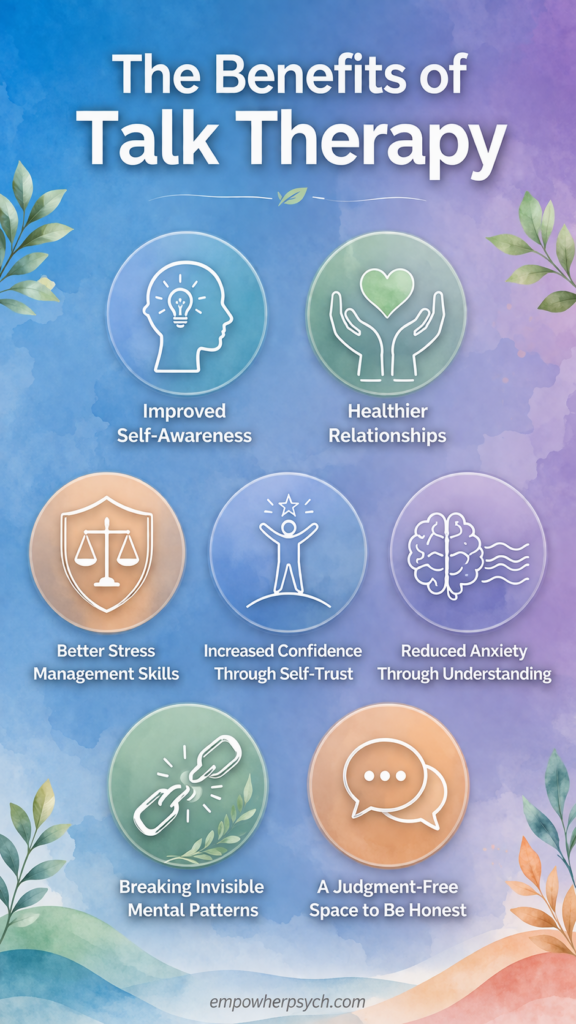
The Benefits of Talk Therapy
The Real Value Goes Beyond Emotional Support
While people often expect therapy to help with stress or sadness, the deeper benefits of talk therapy often show up in unexpected ways. These benefits affect how people think, communicate, and even see themselves.
Here are some of the most meaningful benefits explained clearly:
1. Improved Self-Awareness
Therapy helps people understand why they think, feel, and behave the way they do.
This includes recognizing:
- Personal triggers
- Emotional habits
- Communication styles
- Fear responses
- Motivation patterns
Self-awareness often becomes the foundation for confidence.
2. Healthier Relationships
Another major benefit of talk therapy is learning how to communicate needs clearly and set boundaries without guilt.
People often learn:
- How to express emotions calmly
- How to listen without defensiveness
- How to identify toxic patterns
- How to stop people-pleasing behaviors
- How to maintain respectful boundaries
Many women report that therapy improves not just romantic relationships but friendships, family connections, and workplace interactions.
3. Reduced Anxiety Through Understanding
Anxiety often grows when thoughts remain unexamined. Therapy helps people question fears instead of automatically believing them.
This process helps individuals:
- Separate facts from fears
- Challenge negative assumptions
- Reduce catastrophic thinking
- Build coping strategies
- Develop calming routines
Understanding anxiety often reduces its intensity.
4. Better Stress Management Skills
Stress is unavoidable, but suffering from it constantly is not.
One of the practical benefits of talk therapy is learning daily stress regulation techniques such as:
- Grounding exercises
- Emotional labeling
- Cognitive reframing
- Mindfulness habits
- Time boundary setting
These skills often help people remain productive without burning out.
5. Increased Confidence Through Self-Trust
Confidence often grows when people begin trusting their own judgment instead of constantly seeking validation.
Therapy can help people:
- Trust their decisions
- Stop over-explaining themselves
- Feel comfortable saying no
- Recognize their strengths
- Accept imperfections
Confidence built this way tends to last because it comes from understanding rather than approval.
6. Breaking Invisible Mental Patterns
Sometimes people repeat emotional cycles without realizing it.
Therapy often reveals patterns like:
- Choosing emotionally unavailable partners
- Overworking to feel worthy
- Avoiding conflict to keep peace
- Suppressing emotions to appear strong
- Self-sabotaging opportunities
Recognizing these cycles is one of the most life-changing benefits of talk therapy.
7. A Judgment-Free Space to Be Honest
Many people do not have spaces where they can speak openly without being misunderstood or advised immediately.
Therapy offers:
- Confidential conversations
- Neutral feedback
- Emotional validation
- Objective perspective
- Support without pressure
This safe environment alone becomes one of the most valued benefits of talk therapy.
How Talk Therapy Changes the Way You Relate to the World
The impact of therapy extends beyond self‑discovery. It subtly alters how you experience everyday situations. Conflicts feel less threatening; uncertainty feels manageable. You start to perceive life through a lens of curiosity instead of control.
This shift doesn’t mean your problems disappear — but your relationship with them evolves. You stop seeking perfection and start embracing progress. That change in mindset affects how you work, love, parent, and dream.
Talk therapy, in that sense, becomes a lifelong skill — one that teaches you how to feel deeply without losing direction.
The Ripple Effect on Women’s Well‑Being
When women heal, entire systems — families, teams, communities — begin to heal. Therapy encourages emotional literacy: being able to identify, articulate, and respect emotions without shame.
For working professionals, this often translates to better leadership. Compassionate managers communicate with empathy. Mothers raise emotionally attuned children. Friends become each other’s safe spaces.
The quiet reflection that happens in therapy sessions expands outward, influencing how we build support networks and culture itself. This collective benefit underscores why mental health conversations are vital, not optional.
Talk Therapy as a Catalyst for Growth and Change
Talk therapy isn’t static; it evolves as you do. Some sessions might feel emotional, others strategic. Over time, you begin to internalize the therapist’s guiding voice — asking yourself reflective questions even outside the conversation.
You develop a mental “toolbox” — emotional intelligence, self‑compassion, boundaries, perspective — that you can use daily. The benefits of talk therapy continue long after you’ve left the therapist’s office, quietly empowering you to handle future challenges more gracefully.
Like exercising a muscle, the more you engage with self‑reflection, the stronger and more flexible your emotional health becomes.
Rediscover Yourself: A Mindset Shift Waiting to Happen
Every woman carries layers of stories — some proud, some painful, some still unfolding. Talk therapy gives those stories space to breathe, helping you transform confusion into clarity and tension into understanding. It’s not just about solving problems but evolving into a more centered, authentic version of yourself. The benefits of talk therapy touch confidence, peace, relationships, and purpose — reshaping how you see both yourself and life’s challenges.
And if you’re ready to explore that transformation in a supportive, professional setting, trusted mental‑health experts can guide you. At EmpowHer Psychiatry and Wellness, women and men alike engage in compassionate, evidence‑based therapy that honors your individual journey. It’s not about “fixing” yourself — it’s about rediscovering your power to grow, heal, and thrive. Take the first step toward the perspective shift you’ve been seeking — your story still has beautiful chapters to unfold.
