
Grief is often described as something people feel after losing a loved one, but the truth is far more complex. Grief can show up after divorce, career loss, health changes, childhood wounds, broken dreams, or even life transitions that were supposed to feel happy. Many people silently struggle because their pain doesn’t fit the traditional definition of loss. Understanding the different types of grief helps people realize they are not “too sensitive,” “too emotional,” or “overreacting.” They are simply human. When we learn to recognize grief in its many forms, we also learn how to process it in healthier ways instead of suppressing it.
This guide explores both the well-known and rarely discussed types of grief, including the emotional experiences many people carry quietly. Some of these may surprise you. Some may feel deeply familiar. All of them deserve understanding.
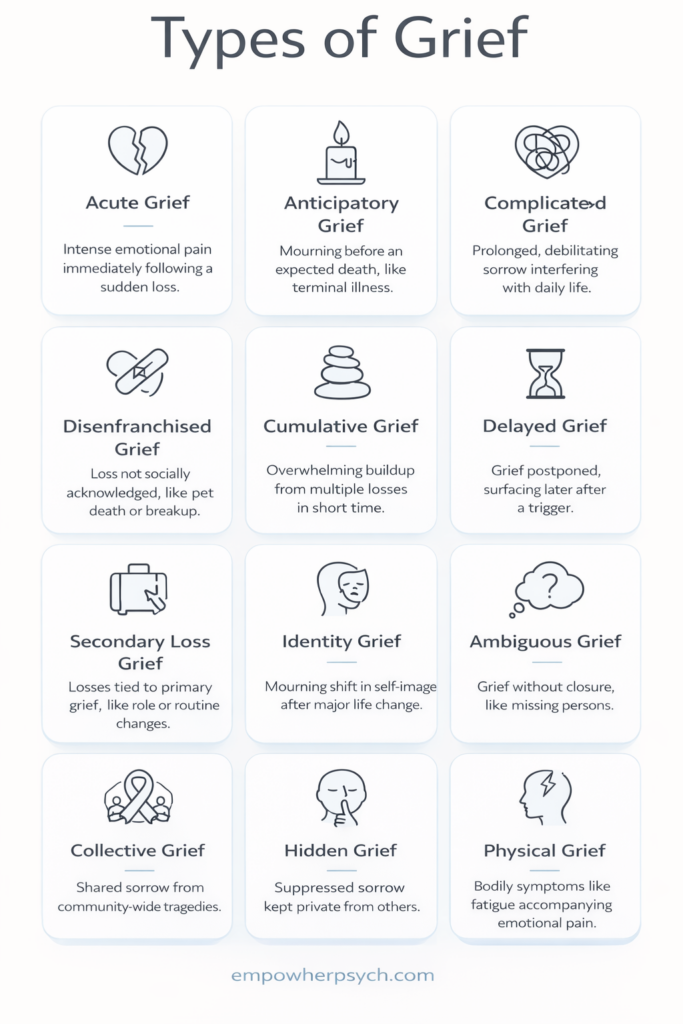
Types of Grief
Grief is not one single experience but can take many different forms, each reflecting how people process loss, change, and emotional pain in their own way.
Acute Grief (The Grief Most People Recognize)
This is the intense emotional reaction most people associate with loss.
Acute grief usually happens shortly after a significant loss. It can feel overwhelming, unpredictable, and physically exhausting. This is the stage often portrayed in movies and widely discussed in society.
Common experiences include:
- Deep sadness or emotional pain
- Crying spells that seem to come from nowhere
- Difficulty concentrating
- Changes in appetite or sleep
- Feeling mentally “foggy”
- Longing for what was lost
Acute grief can also come in waves. Someone may feel okay one day and devastated the next. This unpredictability is normal and does not mean healing isn’t happening.
What many people don’t realize is that acute grief is not limited to death. It can also follow:
- The end of a long relationship
- Losing a job or career identity
- Major financial loss
- A life-altering diagnosis
- Moving away from a meaningful community
Among the many types of grief, this is the one society most easily recognizes, which is why people experiencing other forms often feel misunderstood.
Anticipatory Grief
This is the grief that begins before a loss actually happens.
Anticipatory grief often occurs when someone knows a loss is coming. This could be due to illness, aging, or major life changes. People may feel guilt for grieving someone who is still alive or a situation that hasn’t fully ended yet.
Examples include:
- Caring for a terminally ill loved one
- Watching a parent develop memory loss
- Preparing for a divorce
- Knowing a child is moving away
- Facing a major surgery
This form of grief often includes:
- Anxiety about the future
- Emotional exhaustion
- Moments of detachment
- Trying to “prepare emotionally”
- Feeling guilty for imagining life after the loss
Among lesser discussed types of grief, anticipatory grief can be particularly confusing because people may not feel they have permission to mourn yet.
Complicated Grief
This occurs when grief feels stuck instead of gradually softening over time.
Complicated grief (sometimes called prolonged grief) happens when the intensity of loss does not ease and continues to interfere with daily functioning long after the event.
This may include:
- Feeling unable to accept the loss
- Persistent emotional numbness
- Avoiding reminders of what happened
- Feeling life has lost meaning
- Difficulty reconnecting with others
- Strong feelings of guilt or regret
This does not mean someone is “failing” at grief. It often means the loss was traumatic, unresolved, or tied to other emotional wounds.
Risk factors can include:
- Sudden or traumatic loss
- Loss without closure
- Multiple losses close together
- Lack of emotional support
- Previous trauma
Understanding these deeper types of grief reminds us that healing timelines are not one-size-fits-all.
Disenfranchised Grief

This is grief that society doesn’t always acknowledge or validate.
Disenfranchised grief happens when someone feels they cannot openly mourn because others don’t see their loss as significant.
Examples include grief after:
- A miscarriage
- Loss of a pet
- Ending a situationship
- Estrangement from family
- Losing a friendship
- Infertility struggles
- Loss connected to addiction
People experiencing this grief may hear phrases like:
- “It wasn’t that serious.”
- “You can just get another one.”
- “At least you weren’t married.”
- “Everything happens for a reason.”
Because validation is missing, people often suppress this grief, which can make it linger longer.
Among all types of grief, this one often hurts deeply because the person feels alone not only in loss but in acknowledgment.
Cumulative Grief
This happens when multiple losses pile up without enough time to process each one.
Life sometimes delivers challenges in clusters. Someone may experience several losses within a short time, leaving little emotional space to process any of them fully.
Examples might include:
- Losing a loved one while also losing a job
- Divorce followed by relocation
- Health challenges during financial stress
- Multiple family deaths close together
Symptoms can include:
- Emotional numbness
- Burnout
- Irritability
- Feeling overwhelmed
- Shutdown responses
One of the most overlooked types of grief, cumulative grief often goes unnoticed because people assume the person is just “stressed.”
Delayed Grief
Sometimes grief doesn’t show up when people expect it to.
Delayed grief happens when emotional reactions are postponed, sometimes for months or even years. This can happen when someone had to stay strong, manage logistics, or support others immediately after a loss.
Triggers later may include:
- Anniversaries
- Life milestones
- Hearing certain songs
- Visiting certain places
- Experiencing another loss
Signs may include:
- Sudden emotional reactions long after a loss
- Unexpected sadness
- Anger surfacing later
- Physical symptoms like fatigue
Of all types of grief, delayed grief can surprise people because they thought they had already “moved on.”
Secondary Loss Grief
Sometimes the hardest part isn’t just what was lost, but everything that changed because of it.
Secondary losses refer to the ripple effects that follow a primary loss.
For example, after losing a spouse someone may also grieve:
- Financial stability
- Shared routines
- Social identity
- Future plans
- Emotional security
- Parenting partnership
After losing a job, someone may also grieve:
- Confidence
- Structure
- Purpose
- Professional identity
- Daily social interaction
This is one of the more complex types of grief because people are not just grieving one thing but an entire ecosystem of change.
Identity Grief
This is grief connected to losing who you thought you would be.
This form of grief is rarely discussed but incredibly common. It shows up when life takes a different path than expected.
Examples include grieving:
- The career you thought you’d have
- The relationship you thought would last
- The family you imagined
- Your younger self
- Your physical abilities after illness
- Dreams that didn’t happen
Identity grief often sounds like:
- “I thought my life would look different.”
- “I don’t know who I am anymore.”
- “I feel lost.”
Among emotional types of grief, this one often shows up during major life transitions and can be deeply tied to self-worth.
Ambiguous Grief
This is grief without clear closure or clear answers.
Ambiguous grief occurs when loss lacks certainty or resolution.
Examples include:
- Missing persons
- Estranged relationships
- A loved one with dementia
- Emotionally unavailable parents
- Relationships that ended without explanation
This grief is especially difficult because closure is unclear.
People may struggle with:
- Hope mixed with sadness
- Unanswered questions
- Emotional limbo
- Difficulty moving forward
Among psychological types of grief, ambiguous grief can be particularly exhausting because the mind keeps searching for resolution.
Collective Grief
This is grief experienced by groups, communities, or even entire societies.
Collective grief can follow:
- Natural disasters
- Violence
- Public tragedies
- Global crises
- Cultural losses
People may feel:
- Shared sadness
- Emotional fatigue from constant news exposure
- Fear about the future
- Loss of normalcy
This reminds us that types of grief are not always individual experiences. Sometimes grief is something entire communities carry together.
Hidden Grief (The Ones People Rarely Admit)
Some grief is so personal people don’t even say it out loud.
These forms of grief may include:
- Grieving a toxic parent you never had
- Grieving a childhood you didn’t get
- Grieving feeling unseen in a marriage
- Grieving personal sacrifices
- Grieving time lost to survival mode
- Grieving emotional neglect
This grief often shows up as:
- Quiet sadness
- Emotional triggers
- Difficulty trusting
- Feeling behind in life
- Comparing yourself to others
Among all types of grief, hidden grief is often carried the longest because it is rarely validated.
Physical Grief (How the Body Processes Loss)
Grief is not just emotional. It is physical too.
Many people are surprised to learn grief can affect the body.
Physical symptoms may include:
- Fatigue
- Headaches
- Muscle tension
- Digestive issues
- Chest tightness
- Lower immunity
- Sleep disruption
The nervous system often holds grief even when the mind tries to move forward.
Recognizing physical responses is important when understanding the full spectrum of types of grief because healing often requires caring for both emotional and physical health.
How People Cope With Different Types of Grief
There is no single correct way to grieve.
Healthy coping often involves allowing emotions instead of avoiding them.
Helpful approaches may include:
Emotional processing:
- Journaling thoughts honestly
- Talking with trusted people
- Allowing sadness without judgment
Physical regulation:
- Walking
- Stretching
- Deep breathing
- Maintaining sleep routines
Mental support:
- Learning about grief responses
- Practicing self-compassion
- Setting small daily goals
Connection:
- Support groups
- Therapy
- Community involvement
Healing does not mean forgetting. It means learning how to carry the experience differently.
Why Understanding Types of Grief Matters
Naming what we feel often reduces the shame around feeling it.
When people understand the different types of grief, they often experience:
- Relief (“This has a name.”)
- Validation (“I’m not the only one.”)
- Self-compassion
- Patience with healing
- Better emotional awareness
Perhaps most importantly, understanding grief allows people to stop minimizing their own pain.
- Not all losses are visible.
- Not all grief is loud.
- Not all healing is linear.
But all grief deserves space.
Grief Has Many Faces, And Every One of Them Deserves Understanding
Grief is not just something that happens after death. It can show up after change, disappointment, trauma, growth, and even hope that didn’t turn out the way we expected. Understanding the many types of grief allows us to see that grief is not a weakness but evidence of emotional connection, meaning, and humanity. Whether grief shows up loudly or quietly, immediately or years later, emotionally or physically, it is a natural human response to loss in all its forms. The more we talk about grief honestly, especially the kinds of people rarely mention, the more we create space for real healing instead of silent suffering.
And if you’re realizing that some of these hidden types of grief may be affecting your emotional well-being more than you thought, you don’t have to figure it out alone. Working with mental health professionals can help you understand unresolved grief, emotional patterns, and ways to move forward without dismissing what you’ve been through. If you are looking for compassionate psychiatric support focused on women’s emotional wellness, EmpowHer Psychiatry and Wellness offers personalized mental health care designed to help women navigate life transitions, emotional healing, anxiety, depression, and trauma with understanding and professional guidance. Reaching out for support could be the next step toward not just coping, but truly healing.
