
A person shakes hands at a meeting, then battles rising panic about invisible germs spreading through their body, washing repeatedly despite already clean hands and seeking confirmation from others that they’re safe. The reassurance arrives — “You’re fine, it’s okay” — yet doubt returns within minutes, sharper than before. This relentless cycle defines contamination OCD, where fear of germs, illness, or “tainted” substances dominates daily life despite logical efforts to quell it. Readers will leave understanding core contamination OCD symptoms, why reassurance fails to provide lasting relief, and practical contamination OCD treatment paths that actually interrupt the pattern.
What Contamination OCD Really Is (And What It Isn’t)
Contamination OCD is a specific subtype of obsessive-compulsive disorder centered on fears of being exposed to harmful substances, germs, or environmental dangers. It goes beyond normal cleanliness, turning everyday interactions into sources of intense distress.
People often mistake contamination OCD for mere fussiness. In reality, it involves intrusive thoughts that feel dangerously real, prompting compulsive behaviors to neutralize perceived threats.
Recognizing Contamination OCD Symptoms
Contamination OCD symptoms manifest as persistent obsessions and compulsions that consume time and energy. Common signs include overwhelming disgust or anxiety after minimal contact with feared items.
Key contamination OCD symptoms are:
- Excessive handwashing or showering until skin irritates or bleeds
- Mental rituals like reviewing exposures or imagining illness scenarios
- Physical sensations of “contamination” spreading internally
- Emotional distress so severe it interferes with work, relationships, or self-care
These symptoms create a feedback loop where fear amplifies, demanding more action to achieve fleeting safety.
Common Triggers and Themes

Triggers for contamination OCD vary but cluster around perceived dangers. Public surfaces like doorknobs, money, or elevator buttons often spark panic.
Other frequent themes include:
- Bodily fluids, raw foods, or animal contact
- Hospitals, crowds, or anyone appearing ill
- “Mental contamination” from certain people or memories, feeling “tainted” without physical contact
Contamination OCD doesn’t require visible dirt; the fear alone drives the response, making triggers feel omnipresent.
How the Cycle of Contamination OCD Works
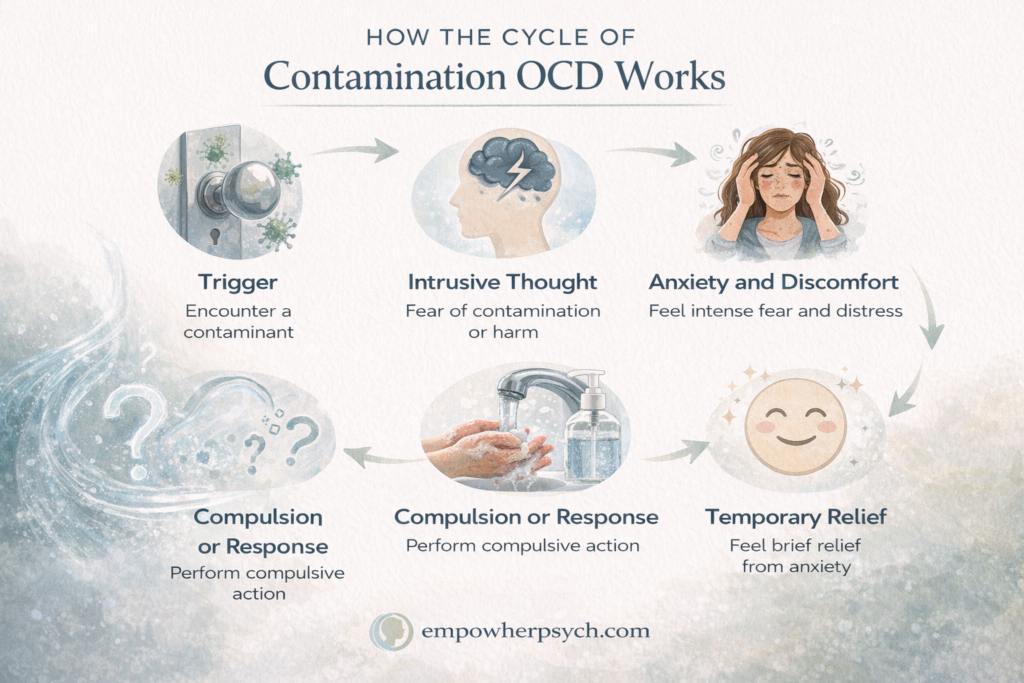
To understand why reassurance never feels like enough, it helps to see the cycle of contamination OCD tends to follow.
A typical pattern looks like this:
- Trigger: Touching a door handle, visiting a hospital, or hearing someone cough.
- Intrusive thought: “What if I caught something?” or “What if I spread this to my family?”
- Anxiety and discomfort: Fear, disgust, or a sense of looming danger.
- Compulsion or response: Excessive washing, cleaning, avoiding, or asking others for reassurance.
- Temporary relief: Anxiety drops for a while.
- Reinforcement: The brain “learns” that compulsions are necessary to feel safe, so the next time anxiety strikes, it demands more.
This loop is what keeps contamination OCD alive. The more someone tries to get to 100% certainty that nothing bad will happen, the more attention and power the fear receives.
Reassurance as a Compulsion
In contamination OCD, seeking reassurance becomes its own ritual. Asking “Did I touch something bad?” or “Will I get sick?” provides momentary calm but functions like washing — a compulsion that sustains the disorder.
Repeated reassurance reinforces doubt. The brain learns safety depends on external validation, not reality, perpetuating contamination OCD symptoms.
Why Reassurance Never Truly Satisfies
Reassurance in contamination OCD feels essential yet perpetually inadequate. Even perfect answers fail because the underlying issue isn’t missing information — it’s intolerance for uncertainty.
People chase absolute proof of safety, but contamination OCD shifts goalposts, generating new doubts immediately after relief.
The Brain’s Demand for 100% Certainty
In ordinary life, most people accept a degree of uncertainty: touching a grocery cart might carry a small risk, but they move on. In contamination OCD, the brain decides that any risk — no matter how small — is unacceptable.
So even if:
- A surface was just cleaned
- A professional confirms there is no meaningful risk
- The person has washed thoroughly
The mind quickly creates new “what if” questions:
- “But what if they missed a spot?”
- “What if this time it’s different?”
- “What if they were wrong?”
Reassurance can’t close every possible loophole, and contamination OCD is skilled at finding new angles. That is why no amount of information ever feels truly complete.
Reassurance Feeding the Obsession
Each reassurance attempt is like scratching an itch — it feels good for a moment but ultimately makes the skin more irritated.
Over time:
- The person trusts their own judgment less
- Anxiety rebounds faster after reassurance
- Obsessions grow more complex or frequent
This doesn’t mean reassurance is “bad” in a moral sense. It simply means that for contamination OCD, reassurance is part of the problem, not the solution, when it becomes a repeated, ritualistic way of coping.
The Emotional Toll of Living with Contamination OCD

Contamination OCD doesn’t just affect handwashing or cleaning routines; it can reshape entire lives.
People may:
- Avoid social events, public spaces, or even hugging loved ones
- Spend hours each day on cleaning rituals
- Struggle to work, parent, or rest without intrusive anxiety
- Feel misunderstood or ashamed, especially if others joke about being “OCD”
Emotionally, many describe feeling trapped between fear and exhaustion. They know their rituals are extreme, but the fear of contamination feels too real to ignore. This internal conflict often leads to guilt, self-criticism, and a sense of isolation.
Partners and family members can be pulled into the cycle as well, offering reassurance or participating in rituals out of concern. Over time, this can strain relationships and reinforce the disorder.
Distinguishing Contamination OCD from Health Anxiety
Health anxiety worries about illness realistically; contamination OCD inflates minimal risks into catastrophes. Normal caution resolves quickly; contamination OCD symptoms linger for hours.
Distinctions include:
- Proportionality: Everyday hygiene calms; contamination OCD escalates despite precautions
- Compulsions: Health worry prompts doctor visits; contamination OCD demands endless rituals
- Duration: Brief concerns pass; contamination OCD dominates daily functioning
Clarifying this empowers accurate self-assessment without minimization.
How Treatment Breaks the Cycle

Contamination OCD treatment targets the obsession-compulsion loop directly, building skills to tolerate distress without rituals. Evidence-based methods outperform reassurance or willpower alone.
1. Exposure and Response Prevention (ERP)
ERP stands as the gold-standard contamination OCD treatment. Therapists guide gradual exposure to feared triggers while preventing compulsions like washing or checking.
A typical progression might involve:
- Touching a “mildly contaminated” object like a library book
- Delaying washing by 15 minutes, then longer
- Progressing to higher-fear items like public toilet handles
- Sitting with anxiety until it naturally decreases
ERP works because it proves contamination OCD symptoms — though uncomfortable — are temporary and harmless. Over weeks, fear shrinks as the brain rewires its threat response.
2. Medication in Contamination OCD Treatment
Selective serotonin reuptake inhibitors (SSRIs) often complement ERP in contamination OCD treatment. Prescribed by psychiatrists, these medications lower baseline anxiety, making exposures more approachable.
Benefits include:
- Reduced intensity of contamination OCD symptoms
- Improved ability to engage in therapy
- Better sleep and mood stability
Medication isn’t a cure but a tool, most effective alongside behavioral change. Regular monitoring ensures optimal dosing without over-reliance.
3. Cognitive Behavioral Therapy Techniques
Cognitive work within contamination OCD treatment challenges distorted beliefs, like “I must eliminate all risk” or “Thoughts predict reality.”
Therapists teach:
- Labeling obsessions as “OCD thoughts,” not facts
- Accepting uncertainty: “I may never feel 100% safe, and that’s okay”
- Mindful observation of anxiety without reacting
These skills endure beyond therapy, helping manage future contamination OCD symptoms flare-ups.
The Role of Loved Ones: Helping Without Fueling OCD

Family and partners often want to help but may accidentally reinforce contamination OCD by providing constant reassurance or participating in rituals.
Helpful approaches can include:
- Setting gentle boundaries around repeated reassurance questions
- Offering support like, “I know this is hard, and I believe you can handle this feeling” rather than detailed safety guarantees
- Encouraging professional treatment instead of trying to solve every fear at home
Over time, loved ones can become allies in recovery — supporting the person’s long-term progress instead of the short-term comfort that reassurance provides.
When Professional Help Becomes Essential
Contamination OCD rarely resolves alone when rituals exceed an hour daily or life significantly impairs. Therapists specializing in OCD provide structured contamination OCD treatment.
Signs include:
- Interference with job or relationships
- Physical harm from compulsions
- Failed self-help attempts
Professionals tailor ERP, monitor medications, and track progress objectively.
Barriers to Starting Contamination OCD Treatment

Fear of intensified anxiety blocks many from contamination OCD treatment. ERP’s initial discomfort mirrors symptoms, prompting delay.
Stigma labels it “just worrying,” minimizing need. Access challenges exist, though telehealth expands options.
Overcoming starts with one step — researching providers or journaling contamination OCD symptoms — building momentum toward relief.
Final Thoughts
Contamination OCD traps individuals in pursuit of unattainable certainty, where contamination OCD symptoms like intrusive fears and compulsive reassurance drive isolation and exhaustion. Reassurance fails because it fuels the cycle, demanding ever-more proof, while contamination OCD treatment like ERP and medication teaches uncertainty tolerance for genuine freedom. Readers now see the mechanisms behind endless doubt and practical paths forward.
EmpowHer Psychiatry and Wellness specializes in compassionate OCD treatment through talk therapy, medication management, and accessible telehealth. Their team crafts personalized plans respecting each woman’s experience. Schedule a consultation today to begin reclaiming ease from contamination OCD symptoms — real change awaits with expert guidance.
